Trains & Buses
Trains
When visiting Japan (especially a major city), trains are usually the primary mode of transportation for tourists. Without a special discount ticket (such as the JR Pass), one will need to pay each time they ride. The fare depends on the distance traveled. In most cases, the longer the ride, the higher the fare. As long as one stays on the same train line, one won’t have to pay an additional fare when transferring between trains.
Depending on the city and the final destination, how one rides and pays can vary slightly. Some trains in Japan run short distances, while others can take passengers across the country. Below is information about the trains one will (most likely) use while sightseeing, and how they differ from one another.
Conventional or Local Line
Known in Japanese as 在来線 (zairaisen), these are older train lines that have been around for many years, not newly built ones. These lines run throughout Japanese cities and also connect large areas of the country, including the Kantō and Kansai regions. Because of this, long-distance trains (excluding bullet trains) can also be classified as conventional or local lines. Short-distance examples include Tokyo’s Yamanote Line and Chūō Line (both rapid and local services). Long-distance examples include the Tōkaidō Main Line (Tokyo–Hyogo Prefecture) and the Sanyō Main Line (Hyogo Prefecture–Fukuoka Prefecture).
Bullet train
Known in Japanese as 新幹線 (shinkansen), these are trains used for long-distance travel across Japan. They run at speeds over 200 km/h (roughly 124 mph) and can take travelers from one region of the country to another in just a few hours. As with other trains in Japan, a ticket is required to ride. Tickets can be purchased on the day of travel at ticket machines or ticket counters at train stations. They can also be purchased online or via a smartphone application. Reservations can be made in advance, and prices vary (depending on the type of seat). There are non-reserved seats, reserved seats, and Green Car seats (which are more spacious and comfortable than those in regular cars).
During the summer holidays and the New Year, many Japanese use the bullet train to visit friends and family. At these times, bullet train tickets often sell out, so it’s best to make a reservation in advance if you are planning to travel then.
Many travel agencies offer packages with both a seat on a bullet train and a hotel reservation at discounted prices. Those traveling without a discount ticket—especially anyone planning to visit a popular tourist destination—may find it worthwhile to check with a travel agency to see if any discounted packages are available.
Streetcar
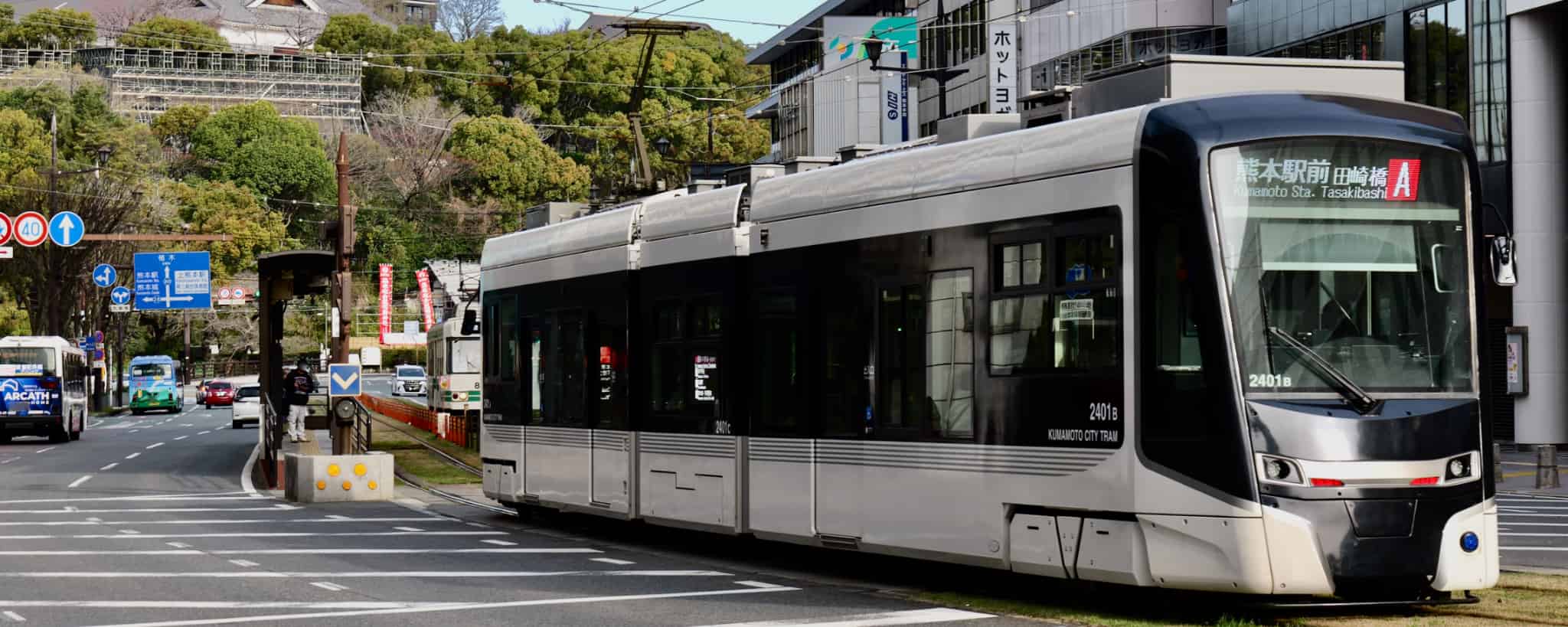
This is a train that runs along the same roads as cars. They were found all across Japan, but as more people began driving, the number of passengers decreased. Now, many of them are being discontinued. However, a few still operate in places such as Hiroshima, Hiroshima Prefecture. One can ride them while sightseeing around the country. From a streetcar, one can enjoy city views that one wouldn’t normally see. It’s a uniquely fascinating way to travel, offering an extraordinary experience.
The system for paying one’s fare on a streetcar is the same as on a bus. Unless paying via a rechargeable transit card, passengers take a numbered ticket from the machine when boarding. In most cases, they pay when getting off by placing the numbered ticket and the fare into the fare box, usually located at the front of the streetcar. Depending on the streetcar, passengers may have to pay in advance, before arriving at their destination.
Monorail
This is a type of train that runs on a single rail. There aren’t many of these lines in Japan, but one can still find a few here and there. One example is the Tokyo Monorail, which, like most monorails in the country, operates over relatively short distances. Many of these trains connect cities to airports, so there is a chance one will ride one when going from the airport to their destination.
Buses
This is a large mode of transportation used when many people need to travel somewhere. It’s not just for short distances within a city; these buses also take passengers across the country. Depending on the destination, it can sometimes be faster to travel by bus than by train or airplane. Some buses even offer inexpensive fares, so in certain cases, one can save money by riding them.
For those traveling on a bus as part of a tour in Japan, the travel agency one has booked with will organize the bus and let one know what to keep in mind when riding on it. For those taking part in a tour and have any questions about the bus they’ll be riding, it would be best to contact the travel agency and ask directly.
Fixed-Route Bus
Known in Japanese as a 路線バス (rosen-basu), these buses are the ones most commonly used by tourists. One will use them (mostly) to get around cities, especially when visiting tourist spots that are a bit too far to walk from the nearest train station. In some tourist spots, certain buses loop around all the major attractions, making it easy to sightsee. On buses that don’t charge a flat fare, one can easily check the fare on the onboard screens.
Shuttle Bus
These buses are usually operated by the hotel (or Japanese-style inn) where guests are staying. Some may charge a fee, but they’re often free. Some buses operate on a fixed schedule, while others require a reservation. For those who’d like to ride one to their hotel or Japanese-style inn, check with the staff in advance to confirm whether the service is available and if there is a fee.
Airport Limousine Bus
These are buses (as their name implies) that run round-trip between airports and major train stations or tourist spots. If one would like to ride one of these buses, tickets can be purchased at the airport ticket counter or ticket machine. One can also reserve tickets in advance through a travel agency or online. On some routes, payment can be made at the destination with a rechargeable transit card or in cash.
In many cases, one can ride these buses more cheaply than other forms of public transportation. We highly recommend these buses for those looking to save some money. There is also a luggage compartment underneath the bus, so one doesn’t have to keep all their bags with them while riding. One can sit comfortably without feeling cramped by luggage.
These buses stop right outside the airport, so one shouldn’t have any trouble finding one. Please note that one generally cannot get off the bus before their final stop, and unscheduled stops are not allowed. If one would like to make any stops in between, it’s best to consult the airport staff in advance.
Express Bus & Overnight Bus
The way one rides and pays the fare for (both of) these buses is (pretty much) the same, so here we’ll explain both of them together. These buses are used when traveling long distances, but the biggest difference is in when one rides them. The express bus is ridden during the day, and the overnight bus (as its name implies) is ridden overnight. With the overnight buses, one arrives at their destination early in the morning. This allows one to start sightseeing on arrival. These buses are great for those with limited time in a certain area. Both of these buses are cheaper than bullet trains and other forms of public transportation, making them a great option for those looking to save money on travel.
To ride either of these buses, one will need to purchase a ticket in advance. A ticket can be purchased over the phone, at a ticket machine, or at a ticket counter at a major bus terminal. Tickets can also be purchased online or at a convenience store. Just like the airport limousine buses, there’s a luggage compartment underneath the bus, so one doesn’t have to keep all their bags with them while riding. One can sit comfortably without feeling cramped by luggage.
One rides these buses at the designated bus stop and gets off at their destination. Generally, one isn’t allowed to get off the bus before their destination, and unscheduled stops aren’t allowed. If one would like to make any stops before their destination, it’s best to consult the companies that run the bus (one will ride) in advance.