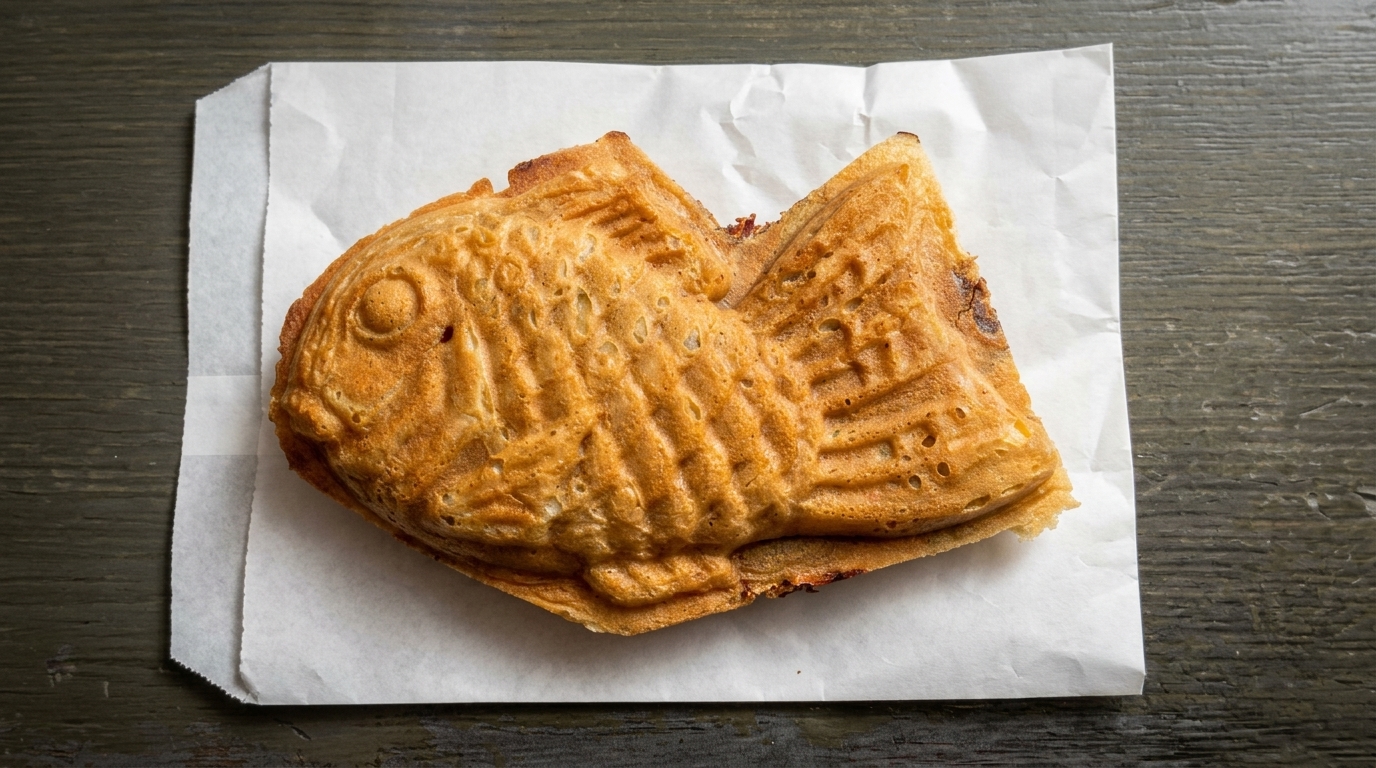
Taiyaki
In Japan, there are 和菓子 (wagashi). Wagashi are Japanese-style confections. Compared with confections and sweets in other countries, wagashi differ greatly in texture and flavor. There are countless types of wagashi, some with a long history and others that are (relatively) new. One of these wagashi is 鯛焼き (taiyaki).
Taiyaki is similar to a waffle, as it's made from flour. Inside this waffle-like pastry is 餡子 (anko)—a sweet bean paste made from 小豆 (azuki) beans. One will also find taiyaki filled with custard, but anko is more common. On certain occasions, taiyaki may also feature seasonal fillings, such as paste made with 抹茶 (maccha—tea leaves finely ground into a powder) and even cherry blossoms. Taiyaki usually costs around ¥200–¥300, but (due to inflation and) depending on the ingredients used, it can often cost more.
鯛 (tai) means “sea bream” in Japanese, referring to the fish, while 焼き (yaki) means “to bake” or “to grill”. Taiyaki was first made in 1909 at 浪花家総本店 (naniwaya sōhonten), a shop in Tokyo specializing in taiyaki. Founded by Seijiro Kanbei, the sea bream shape was chosen because of its celebratory value, and because it’s (at least at the time) also a high-quality fish that most don’t get to eat very often.
As mentioned, taiyaki is baked in the shape of a sea bream. There are two different types of taiyaki baked: a “natural" taiyaki and a “non-natural" taiyaki. The natural taiyaki, also called an 一丁 (icchō) taiyaki, is made one at a time in an individual iron mold. A non-natural taiyaki, also known as a 養殖 (yōshoku) taiyaki, is made by using two iron plates with about five or six molds. Two taiyaki are then attached, with a filling placed inside one of the taiyaki. The icchō taiyaki tends to be crispy, while the yōshoku taiyaki tends to be softer and has more of a waffle-like texture.
The anko filling in taiyaki isn’t unique to this confection. In fact, anko is essential in wagashi. At shops specializing in wagashi, the anko may look similar, but its texture and flavor can vary from shop to shop. The same is true of taiyaki. The anko in taiyaki can differ in texture and flavor from shop to shop. Some anko can be overly sweet, while others have a slight saltiness. The pastry itself also varies from shop to shop. Part of the joy of eating taiyaki is visiting several shops and trying a variety.
As mentioned, taiyaki originated in Tokyo but is now enjoyed throughout Japan. It has become one of the most well-known and popular types of wagashi. Most shops selling taiyaki are small, with little (to no) seating space inside. Taiyaki is usually eaten standing outside the shop where it's purchased or taken home to be enjoyed later. Some shops, though not many, let one eat taiyaki inside. Sometimes, it’s served with green tea. Although anko is said to have originated in China, it has evolved into a distinctly Japanese food. Taiyaki is one of the foods that truly offers a “taste of Japan”. The sweetness of anko pairs well with green tea, and enjoying a cup alongside taiyaki makes the experience all the more delicious.
Although taiyaki may not be considered a “traditional” Japanese confection, it’s certainly one of the most well-known wagashi. Despite similar confections in other parts of Asia, taiyaki is one food that truly reminds one of Japan. Its flavors are unique to Japan. As mentioned, taiyaki is a relatively recent confection, and it's neither upscale nor particularly fancy. Its convenience is part of its appeal. This wagashi will undoubtedly be cherished as a uniquely Japanese confection for years to come.